1.5 weeks without a post? Beginning a sentence--nay, a blog entry--with a number? It must be mid-term...
I posted earlier that one of the ideas that have ruined me is the importance of criticality and doubt in thinking.
I discovered this importance in Pascal's reason-based doubt-proof-submission paradigm outlined in the Pensees. He argues that reason employs the tactics of doubt (trying to disprove something that seems dubious or potentially dangerous to believe - the tool of the skeptic), proof (trying to concretely and inescapably affirm something that seems intuitively reasonable or advantageous to believe - the tool of the mathematician), and submission (accepting a truth by faith - the tool of the theist); to abandon one or two of these tools would result in philosophical shipwreck.
(Note: Given this scheme, "doubt" is not equivalent to "unbelief"---which the Bible identifies as the root of all sin---but simply a questioning of validity. A Christian would certainly want to "doubt" a heretical statement, in that sense. It's more closely akin to modern-day "critical thinking.")
What has struck me as I thought about this paradigm over the last few years is that I have neglected the discipline of doubt for most of my life. (I always dreaded those "critical thinking" questions in English class growing up.)
Now, I can't stop questioning ideas, be they about physics, theology, or how to best carry my books on my way to class!
Even this week, I've spent a good three hours brain-dead over how to prove to my class a simple physics principle used in every introductory textbook. (I'm omitting the particular details here partly out of a desire for relevance and partly out of embarrassment.) I keep reexamining the argument critically, and can't seem to escape!
But this is where the submission comes in: Because of God's commitment to me, I believe I will escape the circle of doubt. (Well, at least over important things; I suppose it doesn't matter if I swim in doubt over unimportant things. --> There - I doubted my own statement again!)
Which tool of Pascal's trifecta have you ignored? Which have you overused?
Thursday, October 21, 2010


Wednesday, October 6, 2010
Ideas That Have Ruined Me - Follow-Up on "Going to Heaven"
I mentioned last week that I've been ruined by the idea that Christians spend eternity on the new earth, and that God comes to us (rather than us leaving a doomed world behind to float in the clouds). A related idea that has also ruined me (though not in my original list) is the thought that I honestly don't know what an unfallen world would look like.
We often make comments that suggest we do know what the restored creation will look like:
"I can't wait 'til heaven, when I'll be talented enough to sing," I read a friend's post on facebook once.
"I can't wait 'til God tells me everything I've ever wanted to know and I can understand it instantaneously," I've often said.
And my personal favorite was R. C. Sproul's off-handed comment in a video I once saw: "Entropy is a great little result of the Fall."
It amazes me that we are so self-derogatory that we think that what we perceive to be insufficient talent is a consequence of our sinfulness, or that having to learn is a mark of imperfection. If even God is described as "learning" in the Bible (yes, I'm aware of the danger of taking such verses out of context, and that's not what I'm doing here--hence the quotation marks), why should our process of learning be a source of shame?
[And I'm still trying to understand how the integral of (1/T) with respect to Q (because that's what entropy is) could be a result of sin... I suspect Dr. Sproul was simply reaching for an illustration.]
What aspects of human life (or the universe in general) do you often attribute to the Fall? Is it necessarily so?
We often make comments that suggest we do know what the restored creation will look like:
"I can't wait 'til heaven, when I'll be talented enough to sing," I read a friend's post on facebook once.
"I can't wait 'til God tells me everything I've ever wanted to know and I can understand it instantaneously," I've often said.
And my personal favorite was R. C. Sproul's off-handed comment in a video I once saw: "Entropy is a great little result of the Fall."
It amazes me that we are so self-derogatory that we think that what we perceive to be insufficient talent is a consequence of our sinfulness, or that having to learn is a mark of imperfection. If even God is described as "learning" in the Bible (yes, I'm aware of the danger of taking such verses out of context, and that's not what I'm doing here--hence the quotation marks), why should our process of learning be a source of shame?
[And I'm still trying to understand how the integral of (1/T) with respect to Q (because that's what entropy is) could be a result of sin... I suspect Dr. Sproul was simply reaching for an illustration.]
What aspects of human life (or the universe in general) do you often attribute to the Fall? Is it necessarily so?
Thursday, September 30, 2010
Ideas That Have Ruined Me: "Going to Heaven"
I blame Andy Crouch for forever ruining my ability to not cringe when Christians refer to what will happen when they "go to heaven."
It was while reading his discussion in Culture Making of the end of the narrative in Revelation that it first really struck me that the end of the story takes place on the renewed earth, complete with a renewed city, renewed trees, gates leading out into the big wide world and letting the nations--still identified as nations--enter. It is to this renewed earth, John describes, that heaven comes down. At the end of the story, then, we don't go up to spend eternity with God in heaven; He comes down to spend eternity with us on earth.
I also blame Andy Crouch for the number of times I've kicked myself that I didn't see this sooner. After all, that's the story of the entire Bible! In Genesis 2 & 3, God comes down to visit Adam & Eve--they don't have to leave the earth behind. In John 1, Jesus comes and "pitches His tent with us" (literal wording for "dwelt among us").
So, why, I've wondered for the last couple years, do we sing so much about what will happen "when we all get to heaven," and how "this world has nothing for me," or even, "this world is not my home?" Granted: The second is likely referring to the world as the system of sin that governs human culture (at least, that's how I sing it--but even then, Crouch argues, we still need culture), but when I hear statements like the third, I can't help but conclude that the writer somehow thinks that this big 6000-km-radius ball of mostly molten iron with a surface gravitational acceleration of 32 ft/s^2 and atmosphere of primarily nitrogen is the wrong place for us. "This is my Father's world"--I want to shout--"and it's also mine!"
This earth is our home--and it will be, for all eternity. That's what makes it so amazing that God would move heaven here to be with us.
Granted, if you see me in church, I'll still sing most of the lines about "heaven," but only because "new earth" just doesn't fit rhythmically. :-P
It was while reading his discussion in Culture Making of the end of the narrative in Revelation that it first really struck me that the end of the story takes place on the renewed earth, complete with a renewed city, renewed trees, gates leading out into the big wide world and letting the nations--still identified as nations--enter. It is to this renewed earth, John describes, that heaven comes down. At the end of the story, then, we don't go up to spend eternity with God in heaven; He comes down to spend eternity with us on earth.
I also blame Andy Crouch for the number of times I've kicked myself that I didn't see this sooner. After all, that's the story of the entire Bible! In Genesis 2 & 3, God comes down to visit Adam & Eve--they don't have to leave the earth behind. In John 1, Jesus comes and "pitches His tent with us" (literal wording for "dwelt among us").
So, why, I've wondered for the last couple years, do we sing so much about what will happen "when we all get to heaven," and how "this world has nothing for me," or even, "this world is not my home?" Granted: The second is likely referring to the world as the system of sin that governs human culture (at least, that's how I sing it--but even then, Crouch argues, we still need culture), but when I hear statements like the third, I can't help but conclude that the writer somehow thinks that this big 6000-km-radius ball of mostly molten iron with a surface gravitational acceleration of 32 ft/s^2 and atmosphere of primarily nitrogen is the wrong place for us. "This is my Father's world"--I want to shout--"and it's also mine!"
This earth is our home--and it will be, for all eternity. That's what makes it so amazing that God would move heaven here to be with us.
Granted, if you see me in church, I'll still sing most of the lines about "heaven," but only because "new earth" just doesn't fit rhythmically. :-P
Wednesday, September 29, 2010
Ideas That Have Ruined Me
Below is a list of ideas that have "ruined" me--i.e., ideas that have forever altered my way of perceiving and thinking about the world around me and how I interact with others' perceptions and thoughts. I hope to write more about each in the coming weeks.
- At the end of the Bible's story, believers spend eternity on the renewed earth, not "in heaven." This has forever changed my reaction to much Christian music and thinking.
- The importance of criticality and doubt in thinking, thanks to Pascal's reason-based doubt-proof-submission paradigm.
- "All truth is God's truth," thanks to Calvin.
- "Calling is the truth that God calls us to Himself so decisively that everything we do, everything we are, and everything we have is invested with a special dynamism and devotion lived out as a response to His summons," thanks to Os Guinness. (My apologies if the wording is out of order, as I'm writing from memory.)
- "An intellectual is someone who loves ideas... A Christian intellectual is [one who does so] to the glory of God," thanks to James Sire.
- "Learning results from what the student does and thinks and only from what the student does and thinks," thanks to Herbert Simon. In my mind, this idea has spent the last six months in an intergalactic collision with the idea that the way we "do church" is not specifically prescribed in either the Old or New Testament.
Thursday, September 23, 2010
A Shift in Focus
When we read the greatest commandment ("You will love the Lord your God will all your heart, with all your mind, with all your soul, and with all your strength," as quoted by Jesus), we usually tend to put the emphasis on the four "all"s. God deserves the complete dedication of our entire being, the commandment says.
Meditating on this commandment in this way has helped me immensely in my walk with God. But I think we can also gain a lot of insight by focusing on the "your"s.
I am called to love God with my heart, with my mind, with my soul, and with my strength. I don't need someone else's heart, mind, soul, or strength. Though God knows I wish I had them, I don't need someone else's emotional intelligence or expressiveness, or someone else's intellectual capability and fortitude, or someone else's endurance and threshold for pain. I can love God in the way that He wants with what makes me who I am.
(Someone might argue that the "you" in this verse is plural, intended for God's people as a whole, and that I'm letting American individualism creep into my thinking. I think the commandment applies in both the singular and plural sense. I wonder, after all, how the second greatest commandment--"You will love your neighbor as yourself"--would be interpreted in a plural manner.)
I find this thought very comforting. I spend too much of my thinking time wondering how someone I admire would respond to a situation, or word an e-mail, or make a presentation; but I can love God in those situations with my personality & internal construction. I don't need someone else's.
Meditating on this commandment in this way has helped me immensely in my walk with God. But I think we can also gain a lot of insight by focusing on the "your"s.
I am called to love God with my heart, with my mind, with my soul, and with my strength. I don't need someone else's heart, mind, soul, or strength. Though God knows I wish I had them, I don't need someone else's emotional intelligence or expressiveness, or someone else's intellectual capability and fortitude, or someone else's endurance and threshold for pain. I can love God in the way that He wants with what makes me who I am.
(Someone might argue that the "you" in this verse is plural, intended for God's people as a whole, and that I'm letting American individualism creep into my thinking. I think the commandment applies in both the singular and plural sense. I wonder, after all, how the second greatest commandment--"You will love your neighbor as yourself"--would be interpreted in a plural manner.)
I find this thought very comforting. I spend too much of my thinking time wondering how someone I admire would respond to a situation, or word an e-mail, or make a presentation; but I can love God in those situations with my personality & internal construction. I don't need someone else's.
Tuesday, September 21, 2010
Are Introductory Physics Problem Dehumanizing?
In my alphabetical album iPod listen-through, I'm currently in the middle of "The Eclipse and Reappearance of the Human in Higher Education," a series of talks hosted by the Christian Study Center of Gainesville in 2008. (Apparently, I need to clean out my podcasts.) It's been refreshing to relisten to these conversations (especially hearing the voices of people from Gainesville I haven't seen in some time).
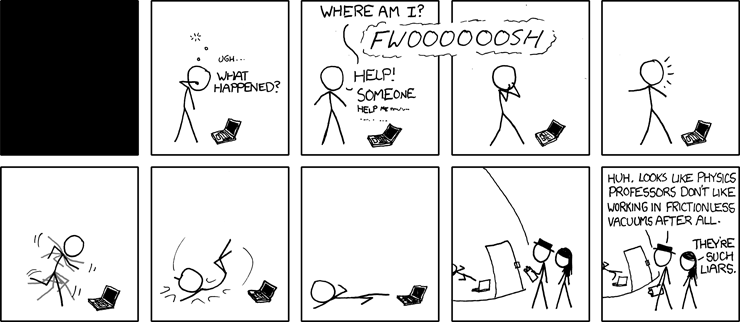
But for the fist time, I turned the question of whether higher education is dehumanizing on my own field of interest: physics education. The first thought that came to my mind was the classic argument between physics professors and their introductory students about all these problems in our textbooks that ask students to ignore friction and air resistance. (Consider the comic above and the classic "spherical cow in a vacuum" joke.)

While I make this argument every semester (Once, I tried to circumvent the argument by asking the students to consider an experiment on the airless moon; I then had to spend half an hour convincing my students that there is no air on the moon...), it occurs to me that one could consider the imposition of these artificial conditions to have a dehumanizing effect on the student.
Think of just a couple implications of a frictionless airless world: First of all, we couldn't live in this world, so our idealized experiments have no humans to operate or watch them. Second, we couldn't walk in this world, because friction is necessary for walking.
If you couple these implications with the stripped-down nature of the objects under consideration in physics problems (purposeless blocks on inclined planes that lead nowhere, spheres and triangles suspended from pulleys for no reason), you quickly find yourself immersed in a human-less (perhaps human-stifling) world.
I think I need to go revise the problems in my own textbook...
Tuesday, September 14, 2010
What We Think We Know & Believe
After many delays, I'm hoping this marks the return of Corner Interactions for the Fall 2010 semester!
I've got many exciting things going on this Fall, including participating in a book club with other JU faculty to read "How Learning Works" by Ambrose, et al.

The first chapter is about how students' prior knowledge about (or related to) a subject area impacts (for better or worse) their learning in that subject area. Prior knowledge & beliefs help learning if they are activated, sufficient, appropriate, and accurate. (Programmers & inductive Bible-study people will notice the AND there.) However, if prior knowledge & beliefs are unactivated, insufficient, inappropriate, or inaccurate, they're actually detrimental to the learning process. (Programmers & inductive Bible-study people will notice the OR there, and notice that a rough statistical estimate suggests that prior knowledge & beliefs harm more often than they help.)
(You might notice I included "beliefs" with "knowledge," which are not terms we usually pair together in academia. However, research increasingly indicates that what a student believes about a subject drastically impacts how well they learn it. I'll write more about that later...)
The authors provide the simple example of students learning the concept of "negative reinforcement" in behavioral psychology, in which students very often associate "negative" with bad, concluding that negative reinforcement is actually a form of punishment (thereby ignoring the "reinforcement" part of the term, which is less familiar).
It seems to me this concept is also true spiritually. Our preconceptions (of what we know & believe to be true spiritually) drastically impact our reception (or rejection) of more spiritual truth. Perhaps, even, the majority of our disagreements as Christians come from unactivated, insufficient, inappropriate, or inaccurate prior spiritual knowledge & beliefs?
I've got many exciting things going on this Fall, including participating in a book club with other JU faculty to read "How Learning Works" by Ambrose, et al.
The first chapter is about how students' prior knowledge about (or related to) a subject area impacts (for better or worse) their learning in that subject area. Prior knowledge & beliefs help learning if they are activated, sufficient, appropriate, and accurate. (Programmers & inductive Bible-study people will notice the AND there.) However, if prior knowledge & beliefs are unactivated, insufficient, inappropriate, or inaccurate, they're actually detrimental to the learning process. (Programmers & inductive Bible-study people will notice the OR there, and notice that a rough statistical estimate suggests that prior knowledge & beliefs harm more often than they help.)
(You might notice I included "beliefs" with "knowledge," which are not terms we usually pair together in academia. However, research increasingly indicates that what a student believes about a subject drastically impacts how well they learn it. I'll write more about that later...)
The authors provide the simple example of students learning the concept of "negative reinforcement" in behavioral psychology, in which students very often associate "negative" with bad, concluding that negative reinforcement is actually a form of punishment (thereby ignoring the "reinforcement" part of the term, which is less familiar).
It seems to me this concept is also true spiritually. Our preconceptions (of what we know & believe to be true spiritually) drastically impact our reception (or rejection) of more spiritual truth. Perhaps, even, the majority of our disagreements as Christians come from unactivated, insufficient, inappropriate, or inaccurate prior spiritual knowledge & beliefs?
Subscribe to:
Posts (Atom)